芝全交智恵之程
- タイトル
- 芝全交智恵之程
- タイトル(ローマ字)
- Shiba Zenkō chie no hodo
- タイトル(翻訳)
- The Extent of Shiba Zenkō's Talent
- 著者
- 芝全交(Shiba Zenkō, 1750-1793)
- 画工
- 北尾政演(Kitao Masanobu, 1761-1816)
- 出版者
- 蔦屋重三郎(Tsutaya Jūzaburō, 1750-1797)
- 出版年
- 1787
- 所蔵機関
- National Diet Library 国立国会図書館
- 他の伝本・版
- 国会,東洋岩崎,京女大,京大潁原,東大教養(「智恵之程」),阪大,日比谷加賀,日比谷東京,岩瀬,大東急,学書言志,[補遺]慶大
- IIIF Manifest
- https://iiif-depot.honkoku.org/iiif/manifests/3b7946c7-918c-4a30-896e-922cdfe80ec8/manifest.json
- 他の伝本・版のリンク
- https://kokusho.nijl.ac.jp/biblio/100379442/1?ln=ja (大阪大学附属図書館,黄表紙,913.5/K3/1(14-30))
https://kokusho.nijl.ac.jp/biblio/100053931/1?ln=ja (東京都立中央図書館,加賀文庫,55‐15: )
https://kokusho.nijl.ac.jp/biblio/100093665/1?ln=ja (東京都立中央図書館,東京誌料,4752‐240:)
https://kokusho.nijl.ac.jp/biblio/100338702/1?ln=ja (法政大学図書館,古川久文庫,913.5:38)
https://kokusho.nijl.ac.jp/biblio/300066158/1?ln=ja (東京大学教養学部国文・漢文学部会,一般,4183:14)
校訂文
第 1 コマ
全交つく〴〵思ふ様、「額へ穴の開きたる人をきれいに治したる事稀なり。我きれいニ穴を埋めん」と古今の智恵を振ふ。その治し様は、割竹ニ火を灯しつけ、それを口の内へ入れて、穴の中へ松脂を詰め、上より白鑞を流す。1治る事妙なれば、門前を市をなす。
後々は世人の救ひのためとて、町々を呼ばわつて歩き、金儲けをする。その呼び声は「下疳2、瘡毒3、治し〳〵。4」
「モシ、お医者さん。薬缶頭も治りやすか。」
「口をあんとお開けなさい。はなの取り換へは古いのを下ニ取て廿四文お出しなさい。」
「夜鷹5の方でも廿四文づゝでとりますね。」
この治療は、身体を治すための治療ではなく、銅鉄器の破損を溶接して補修する方法である。この場面における全交は鋳掛師の見立てである。鋳掛師とは、「銅鉄器の破損を溶接して補修するのを業とする者。中世・近世では、燃料・ふいごを携えて歩き、路上で火を用いて業とする者もあった。」とのことである。(『角川古語大辞典』より)。鋳掛屋とも言えた。
鋳掛師の画像は#aでご確認いただける。
↩下疳とは、性交によって伝染する潰瘍の一種で、「江戸時代の語で、梅毒の一症状をいう(一本堂行余医言)。陰部に生ずる潰瘍。性交で感染し、これにかかれば色欲が生じても事が遂げられない。」(『角川古語大辞典』より)
↩瘡毒は、性病の一種であり、梅毒とも言う。
↩「下疳、瘡毒、治し〳〵」とは鋳掛師の売り声のパロディである。
鋳掛師の売り声は講談『鋳掛松』で聞いていただける。講談師の神田伯山の「鋳掛松」(0:47-0:49)でご確認いただける。
↩「夜鷹」とは「街娼。江戸での称。上方では惣嫁という。娼婦稼業の最下級の者で、手拭で頰かむりをし、その端を口にくわえ、むしろ一枚を持ち、材木置き場などの物陰に立って客をひく。むしろがそのまま床の代用をなす。粗末な夜鷹小屋に客を引き入れ、あるいは戸外で事を行うゆえ、「夜鷹の尻としら玉は寒ざらし(柳多留・一〇七)」「夜鷹の願イどふぞ畳の上へで仕たい(柳多留・一五二)」などという。近世中期で、「夜鷹の道中波銭の六文字(柳多留・一四六)」とあるように、価二十四文。(下略)」(『日本国語大辞典』より)
夜鷹の画像を#cで確認いただける。
↩
翻訳
第 1 コマ
Zenkō gave it lots of thought. “It is rare to fix a man with a hole in his forehead. But I’ll repair it!” So he unleashed is exceptional talent. The treatment goes as follows. He sets fire to a split bamboo and pushes it through the patient’s mouth. He then fills the hole with pine resin and finishes off by pouring pewter on top.6 Given the wondrous recovery, his place was swarming with people.
After that, claiming that it was for the good of the world, he began delivering his cures walking around the city, with a view to make a profit by shouting: “I treat chancres and syphilis! I treat syphilis!”
"Hey doc! do you also cure heads which are bald a kettle?"7
"Open your mouth…Ahhhhh… To substitute your old snout, much like I would do with an old spout, give me 24 copper coins." 8
"A street prostitute 9 asks for the same price: 24 copper coins!"
The treatment described here is no medical treatment. It is the method used by early modern Japanese tinsmiths to mend holes in pots and kettles. This creates a form of double vision (mitate): Zenkō, the doctor, is in fact a tinsmith.
In Japanese* ikakeshi *鋳掛師 or ikakeya 鋳掛屋, this crafstman used to work on the streets, carrying a bellows to produce the necessary air to have the fire that was necessary to mend holes.
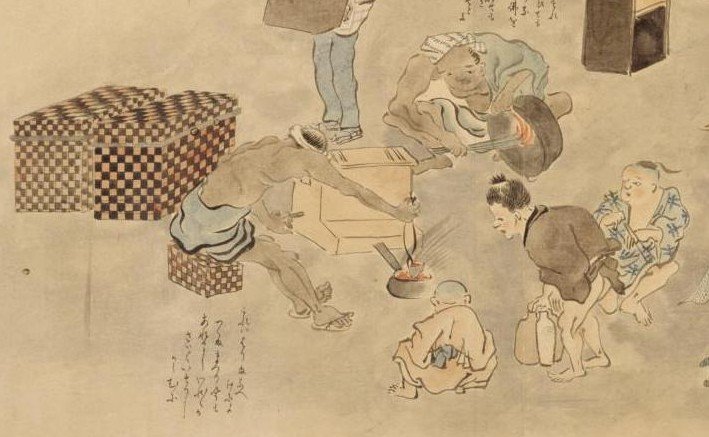 Image from illustrated scroll Shokunin zukushi e-kotoba 職人尽絵詞, illustrated by
Kuwagata Keisai 鍬形蕙斎 (aka Kitao Masayoshi 北尾政美). Copy held at the National Diet Library, shelf mark 寄別1-4-7; DOI https://dl.ndl.go.jp/pid/11536004/1/5.
A later image, a photograph by Kusakabe Kinbee 日下部金兵衛 (1841-1932 or 1934), shows a tinsmith (tinker) at work.
↩
「下疳、瘡毒、治し〳〵」とは鋳掛師の売り声のパロディである。
鋳掛師の売り声は講談『鋳掛松』で聞いていただける。講談師の神田伯山の「鋳掛松」(0:47-0:49)でご確認いただける。
↩Here the translation renders the pun contained in the word hana used for its sound that can double up to mean "nose" ("snout", in logographic character 鼻) and "handle" (here render as "spout", in logographic character 端). Here the text plays on the idea that the patient is suffering from syphilis, contracted by having sex with a street prostitute; one of the symptoms of syphilis being sever nasal damage.
↩The word "street prostitute" points to the so-called yotaka 夜鷹. She would normally cover the head with a cloth and carry a straw mat that she would use to perform sex with the clients. The price was fixed at 24 copper coins (very low if we consider that a bowl of soba noodles towards the end of the eighteenth-century was 16 copper coins). Sources of information about the price of a street prostitute can be verified in note #5.
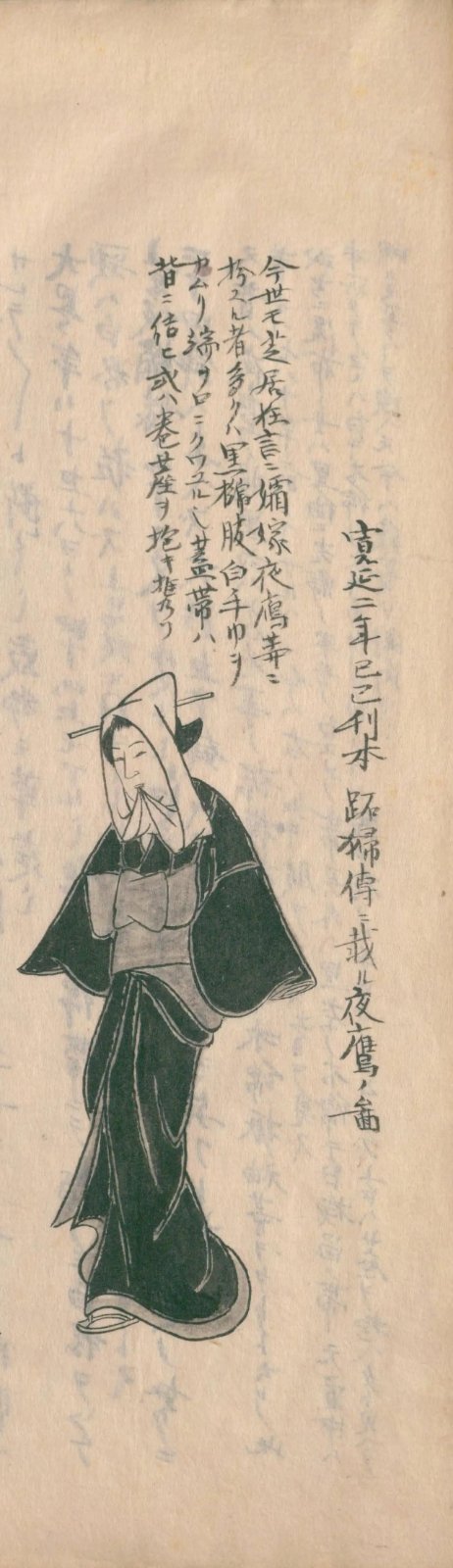
Kitagawa Kisō 喜田川季荘, Morisada mankō 守貞謾稿 (also known as Kinsei fūzoku shi 近世風俗志), manuscript complete between 1837 and 1853. Copy held at the National Diet Library, shelf mark 寄別13-41; DOI 10.11501/2592408. Image from volume 22.
↩
翻刻
第 1 コマ
せんかうつく〳〵思ふやうひたいへ
あなのあきたる人をきれいに
なをしたる事まれなりわれ
きれいニあなをうめんとこゝんの
ちゑをふるふそのなをしやうは
わりだけニひをともしつけそれ
を口のうちへいれてあなのなかへ
まつやにをつめうへよりしろみを
なかすなをる事
めうなれは
もんせんいちを
なす
のち〳〵はせいじん
すくひのためとて
まち〳〵を
よばわつてあるき
かねもふけを
そのよび
こゑは
する
〽げかん
そうどく
なをし〳〵
〽モシ
おいしや
さん
やくはん
あたまも
なをり
やす
か
〽口をあんと
おあけ
なさい
はなの
とりかへは
ふるい
とつて
廿四文
のを下ニ
おだし
なさ
い
〽よ
たか
の
ほう
でも
廿四文
つゝで
とり
ま
す
ね
あふぎいろ〳〵
諸流御舞扇